
Quick answer: In Tokyo, Osaka and Kyoto, Docomo and SoftBank both give fast, stable data, and most travelers won't notice a difference. Outside the cities, Docomo usually covers more: mountain resorts, rural rail lines and smaller islands. The safest choice is an eSIM that can use both networks, so you can switch when one is weak.
Japan's four mobile networks
| Network | Owner | What travelers should know |
|---|---|---|
| NTT Docomo | NTT | The largest carrier in Japan. Wide rural coverage |
| SoftBank | SoftBank Corp. | Strong in cities. Common on travel eSIMs |
| au | KDDI | Strong in cities and ranks well on reliability. Common on travel eSIMs |
| Rakuten Mobile | Rakuten | Newest network. Thinner coverage outside cities, which it fills by roaming on au |
Travel eSIMs don't give you a Japanese SIM. They give you a foreign SIM that roams onto one or more of these networks. The network names a provider lists are the networks your phone is allowed to join. The ZenRoam Japan eSIM can join Docomo and SoftBank.
Docomo vs SoftBank at a glance
| Docomo | SoftBank | |
|---|---|---|
| Tokyo, Osaka, Kyoto | Fast and stable | Fast and stable |
| Crowded spots (Shibuya Crossing, festivals) | Can slow at peak times | Usually holds speed well |
| Countryside and mountains | Usually the widest coverage | Good on main roads and towns, thinner in remote valleys |
| Ski resorts (Niseko, Hakuba) | Usually strongest on upper slopes | Good in villages and at the base |
| Shinkansen and subways | Good | Good |
| 4G bands (main) | 1, 3, 19, 21, 28, 42 | 1, 3, 8, 11, 28, 41 |
| 5G bands | n78, n79 | n77 |
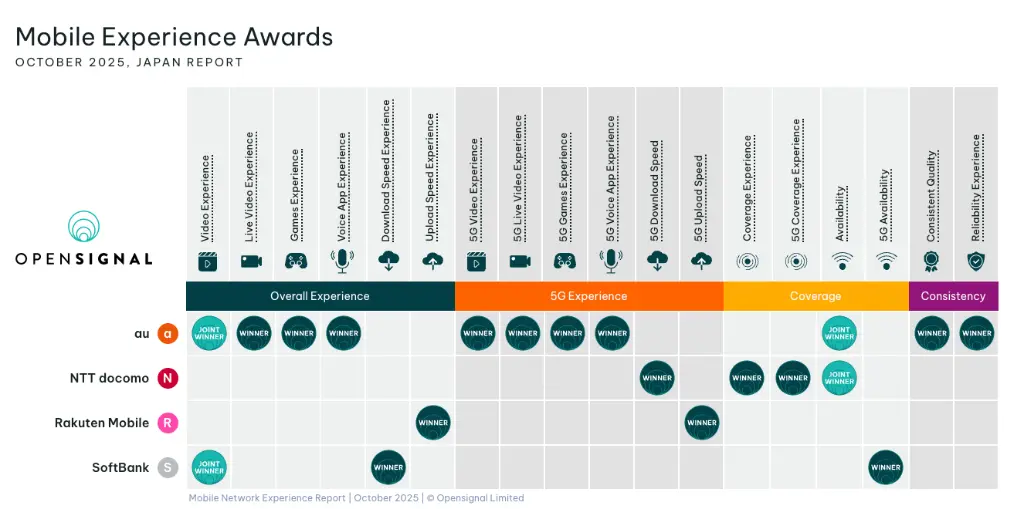
What the independent tests say: Opensignal publishes a Japan report twice a year. Their recent reports have given Docomo the edge on coverage, and SoftBank and au the edge on download speed and consistency.
In the cities: it's close
In central Tokyo, Osaka, Kyoto, Nagoya, Fukuoka and Sapporo, both networks are good enough for maps, video calls and uploading photos. Choose your eSIM on price, data size and hotspot rules instead.
The one place you may notice a difference is a very crowded spot at peak time: Shibuya Crossing on a Friday night, a fireworks festival, a stadium. When a cell is busy, speed drops for everyone on it. If your eSIM can use a second network, switching usually helps (see the steps below).
Outside the cities: Docomo usually wins
Docomo has long built its network to cover the most ground, including low-frequency 800 MHz (band 19) for mountains and rural areas. That's why it's usually the stronger choice in places like:
- The Japanese Alps (Kamikochi, Hakuba, Tateyama)
- Ski areas in Hokkaido and Nagano
- Rural rail lines and hiking trails such as the Kumano Kodo and Nakasendo
- Smaller islands in Okinawa and the Seto Inland Sea
SoftBank still covers the towns and main roads in these areas well. The difference shows up in the gaps: a valley, a ridge, a long stretch of forest.
Check your phone's bands. Most recent iPhones and Samsung Galaxy phones sold in the US support Japan's main 4G bands. Older or budget phones sometimes miss band 19, Docomo's rural band, which matters most outside cities. Many US phones also lack 5G band n79. That only means less 5G on Docomo: the phone still connects on n78 or 4G. Check your model's band list before you buy. Older or budget phones may miss some. See our eSIM compatible devices list.
How to switch between Docomo and SoftBank by hand
Your phone picks a network automatically. If the signal is weak, you can choose the other one yourself.
iPhone:
- Open Settings > Cellular (or Mobile Data).
- Tap the ZenRoam line.
- Tap Network Selection and turn off Automatic.
- Wait up to a minute for the list, then tap NTT DOCOMO or SoftBank.
Android (Samsung):
- Open Settings > Connections > Mobile networks.
- Tap Network operators, then choose the ZenRoam SIM.
- Turn off Select automatically and choose a network from the list.
Turn Automatic back on when you return to the city, so your phone can move between networks again.
Which should you choose?
- City trip only (Tokyo, Kyoto, Osaka): either network. Choose on price.
- City plus day trips (Nikko, Hakone, Nara): either works, and two networks give you a backup.
- Skiing, hiking, rural Japan or islands: choose an eSIM that lists Docomo.
- Working from a laptop: choose a plan that allows hotspot. Both networks handle video calls well in cities.
Continuing to South Korea? Korea's networks are different again. Our Korea eSIM uses LG U+, one of the country's three national carriers.
If you are still comparing providers, our Japan eSIM comparison lists eight of them with their networks and prices. For winter trips, see staying connected in Hokkaido.
Questions travelers ask
Does it matter which network my Japan eSIM uses? In big cities, not much. Outside them, yes. Docomo usually reaches further into the mountains and countryside.
My eSIM lists SoftBank only. Will it work in Kyoto and Osaka? Yes. SoftBank covers all the major cities and tourist areas well.
Can I use both Docomo and SoftBank on one eSIM? Only if your provider allows it. The ZenRoam Japan eSIM can use both. Your phone chooses one at a time, and you can switch by hand.
Why is my speed slower than a Japanese friend's phone on the same network? Roaming eSIMs route data through the provider's network, which adds delay, and some providers set a speed limit. Check your plan's details.
Is au (KDDI) better than both? au does very well in independent tests, and many travel eSIMs use it. ZenRoam's Japan eSIM does not use au.